Beginning in Beekeeping?
Page under construction

Page under Construction
Find out how bees make honey and how man has learnt their secrets.
The honeybee is the most amazing creature in the insect world. The bee’s body is delicate, her life is short and enemies are many. Yet these daunting drawbacks are shrugged off as the bee goes daily about her task of collecting nectar and pollen to take back to the hive so that future generations of bees can thrive. And the bee is willing to die to defend the hive.
Even though throughout history man and animals have plundered beehives for a taste of honey, the honeybee has survived and adapted to climates and conditions far removed from that where bees were first recorded.
Bee Biology
If we journey back 4000 years to ancient Egypt, hieroglyphics show the story of the bee’s life. So primitive man had discovered the delight of honey by then — for centuries it was the only sweetener available. In the 4th century B.C., Aristotle wrote of the bee. Three hundred years later, Virgil the poet and Pliny the naturalist, carried the story further. In England under Saxon rule, honey was accepted by some landlords as part-payment for rent from tenants. The bee had truly earned a valuable place in society.
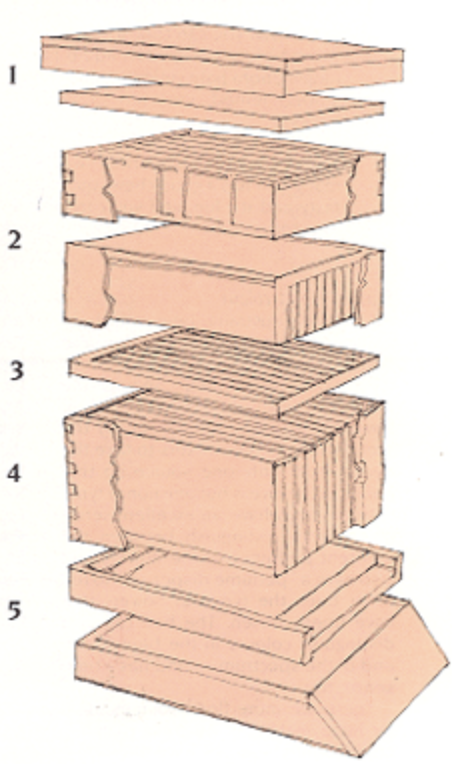
In 1792 a blind naturalist, Huber, published a book in Geneva on bees and honey. The honey industry that we know today began to grow. Sixty years later in Philadelphia, Lorenzo Lorraine Langstroth, a minister and teacher, invented a new kind of beehive. It was a rectangular wooden box in which he stood a row of frames. Each frame provided a place for bees to build the wax cells that form the honeycomb. The frames could be taken out separately so that one honeycomb could be removed without hurting the others. The Langstroth hive is used by all Australian beekeepers today.
The Type of Bees
The Queen Bee
The Queen is the centre of the hive: She accompanies every-swarm that you see. The Queen is also the largest bee and her body is specially formed for egg-laying-so that the eggs can be placed a little above the centre of the cells in the honeycomb. Before depositing her eggs, she inspects each cell to be sure it is properly cleaned by the workers. Just think of her effort and industry!
When, for any reason the colony needs a new Queen; extra royal jelly is fed to chosen larvae in the cells. The first young Queen to emerge from the pupa destroys all other developing Queens in the cells, then sets out on her mating flight after five to twelve days. After mating the young Queen has much to do. With her eggs fertile, she must return swiftly to the hive. The old Queen will have left with a swarm beforehand. The new Queen, closely surrounded by worker bees who feed and groom her, can lay up to one egg every minute day and night.
The Type of Bees
The Drones
Drones are the future fathers of the bee colony (rather a very small number of them will be). Shorter than the Queen, drones are larger than the workers. They have no accomplishments other than being patient. They cannot make wax, have no proboscis for collecting pollen or nectar, and have no pollen pikes on their legs. They are never called on to defend the hive so they have no need for a sting.
Drones rarely feed themselves – instead, they hold out their tongues and a worker bee places food on it. They are truly gentlemen in waiting. They are waiting for the day when a young Queen will fly from the hive. When a new Queen flies from the hive she joins the drones, who are already circling in drone congregation areas: The swiftest drones will catch and mate with the Queen, but their life is short. After mating, they will float back to earth and be dead by the time they reach the ground: They have helped to bring new life to the colony and their work is finished. The remaining drones return to the hive either to be driven out or to die there during the winter or when a shortage of food occurs.
The Type of Bees
The Worker Bees
The main section of the hind pair of legs has special spines for holding pollen or propolis (a kind of gum). The centre legs are the bees’ main support, but all six legs are variously equipped with brushes, combs and spurs with which to brush pollen from the eyes, clean the antennae, wipe dust from the wings and pack pollen spines. The tongue and mandibles are used to lick and collect pollen grains from the anthers of flowers, with the result that the pollen grains are moistened with honey and stick together. The pollen is then transferred to the hind legs and held firmly until the forager enters the hive, when it is then packed in cells in the honeycomb.
Worker bees have two heavy spoon-shaped jaws which work sideways. The jaws are used for collecting pollen and chewing wax. The abdomen has two important organs – the wax glands and the sting. Wax glands are special cells on the underside of the last four segments of the body. Wax is discharged through these special cells in tiny scales, which are then moulded and used in comb building, capping and the cells.
Typical Hive Setup